We will be having some hot days over the next five to seven days. The hot days are very beneficial for nectar production. Bees can forage earlier and longer during these days. Warm days and warm nights make the Basswood flow.
Make sure you are checking your supers once a week. If there is a good nectar flow and your hive has a good population, the bees can draw out fill and cap a super in a week. A hive with supers with drawn comb can fill and cap 1-1/2 supers in a week. This is why we need to put supers on two at a time during the first three weeks of the main nectar flow.
Stay ahead of the bees, this is how you get more honey. If the hive gets full of honey and the supers are not being put on ahead of the bees. The bees will stop collecting nectar.
The next month is the payoff month. Everything beekeepers have done to manage their colonies is happening now.
Friday, June 26, 2020
Thursday, June 25, 2020
The Nectar Flow
 |
| Basswood tree in bloom. When the flowers open up, the pungent odor of the nectar fills the air. |
 |
| Little white flowers on the Basswood tree. Notice the light lime colored leaves. When these light lime green leaves open that exposes the flower heads. My Basswood trees this year do not have any of these as of yet. |
I think most of us are experiencing a nectar flow. It may or may not be intense.
I talked to a beekeeper that lives near me north of Stillwater, he has one super being capped and was adding another super that had foundation. He wanted to know the best way to put it on the hive. I suggested that the undrawn new foundation should go on top of the queen excluder and his box of honey that is being capped be put on top. He could also take one frame from the top super and switch it to the bottom box to bait the bees into the new box of frames.
Basswood trees have been blooming in St Paul and in Stillwater that I have observed. My Basswood trees have not dropped any seed pods and at the time of this post, I do not believe that my Basswood trees are going to produce anything this year. I am not sure if this is just at my place or if this will be widespread. Basswood nectar is what usually gives beekeepers large crops of honey. Without a good Basswood flow our honey crops tend to be on the smaller amounts. Sometimes Basswood flows can be localized and sporadic. Too early to tell yet.
White Sweet Clover (WSC) is beginning to bloom. I did see some blooming WSC on the 694 freeway. Roadways and cities usually are area's that bloom first so soon WSC should be blooming everywhere.
Don't fret yet. Sometimes the main nectar flow starts with a trickle, then turns to a torrent very quickly.
I think another week should tell the tale of how this flow will develop. I am hoping to see the nectar gate will lift up fully.
My supers in one yard were getting nectar into the boxes. I am going to check them in a day or two and give another report, so stay tuned.

Friday, June 19, 2020
Varroa on an untreated overwintered colony of bees UPDATED
My friends overwintered bees died. He treated them but never did a mite check to see if the treatment worked. Possibly the bees came out of winter with a high mite count. Even though he treated for Varroa, the hive still died. The treatment probably was too late to save the bees. He went to look at them a week ago and all of the bees were gone. This is a symptom of Varroa. One week the bees look great, the next week there are no bees in the hive. Sometimes there is a small cluster of bees with the queen left.
If you have an overwintered hive and you have not done a mite check, I strongly urge you to do so now. It might even be too late to save some of them. But by mid July, untreated overwintered colonies may be empty of bees.
One of the only mite treatments that can be used during a nectar flow is Mite Away Quick Strips (MAQS) or Formic Pro. Both of these treatments are Formic Acid. They cannot be put on if the daily temperatures exceed 85 degrees F. during the first three days they are on. But the honey supers can be on when using this type of mite treatment. MAQS is a seven day treatment, Formic Pro is a fourteen day treatment. When you put formic on, you should not have messed with your bees for three days. Meaning, if you looked at your bees, pulled some frames, did a mite check etc. The hive should be closed up and the formic should be put on three days later. If you put the formic on immediately after you dug into the hive, jumbling up the bees, you can have a greater mortality to the bees.
Monday, June 15, 2020
What is happening now in the hive
We have now crossed mid June today. Flowering plants are starting to be seen in large numbers. Yellow Sweet Clover is blooming all around the metro area.
Yellow Sweet Clover is not our best nectar plant in the eastern part of MN and WI. Yellow Sweet Clover seems to produce more nectar in drier environments, like western MN and the Dakota's, Nebraska, Wyoming and Montana.
White sweet clover will be blooming soon. I do see it growing in the ditches.
I would think in the next 10 days the main nectar flow will be coming on strong.
If your hive hasn't finished drawing out the last deep box, it probably will be too late to do a reversal. If your top box is very heavy with honey, DO NOT do a reversal. This box will be the hives winter stores. If the hive's top box is pretty much finished and the box is not full of honey you can do a reversal.
Everyone should be putting on their honey supers now. If the honey supers are all foundation, I usually put the supers on without a queen excluder at first. Check the supers every four days, once there is some comb being built and some nectar in the cells, then put your queen excluder on.
Supers go on two at a time. If you have drawn out supers, just set them on top of the queen excluder.
As supers fill up, drawn out supers can just be stacked on top of the supers that are partially full or full. Stay ahead of the bees. When the second super is getting honey on a few frames, it is time to add two more supers. Stay ahead of the bees in the first half of the honey season. When it gets to be around July 21st or so, the honey may be slowing down a bit and the supers may not fill up as fast.
When putting on supers with undrawn foundation, these new frames have to placed just above the queen excluder. If you place new frames on top of other already drawn supers, sometimes the bees won't touch them.
The queen excluder debate: Some beekeepers call queen excluders honey excluders. Some beekeepers say when they put on queen excluders they never get any honey. The truth of the matter is, many times when this has happened to a beekeeper, the reason no honey goes into the supers is because their hive has swarmed and they don't realize this has happened. I know a commercial beekeeper who runs 5,000 hives. He has queen excluders on every hive. I can honestly say that if he would get more honey without queen excluders he would not use excluders. He has to clean the excluders every year, this costs him money to do this, so he does see value in using excluders. So he does use them and has huge honey crops most years. This is his livelihood. So he will use whatever works best for him.
Get your supers on. Our hard work of starting the bees and doing all the management is about to pay off. The honey flow is about to start any time now. As Basil Furgala said, you can't make honey if your supers are in your garage.
 |
| White Sweet Clover, this is one of our main nectar plants |
 | |||
| Yellow Sweet Clover, this plant is not our main nectar plant | . |
Yellow Sweet Clover is not our best nectar plant in the eastern part of MN and WI. Yellow Sweet Clover seems to produce more nectar in drier environments, like western MN and the Dakota's, Nebraska, Wyoming and Montana.
White sweet clover will be blooming soon. I do see it growing in the ditches.
I would think in the next 10 days the main nectar flow will be coming on strong.
If your hive hasn't finished drawing out the last deep box, it probably will be too late to do a reversal. If your top box is very heavy with honey, DO NOT do a reversal. This box will be the hives winter stores. If the hive's top box is pretty much finished and the box is not full of honey you can do a reversal.
Everyone should be putting on their honey supers now. If the honey supers are all foundation, I usually put the supers on without a queen excluder at first. Check the supers every four days, once there is some comb being built and some nectar in the cells, then put your queen excluder on.
Supers go on two at a time. If you have drawn out supers, just set them on top of the queen excluder.
As supers fill up, drawn out supers can just be stacked on top of the supers that are partially full or full. Stay ahead of the bees. When the second super is getting honey on a few frames, it is time to add two more supers. Stay ahead of the bees in the first half of the honey season. When it gets to be around July 21st or so, the honey may be slowing down a bit and the supers may not fill up as fast.
When putting on supers with undrawn foundation, these new frames have to placed just above the queen excluder. If you place new frames on top of other already drawn supers, sometimes the bees won't touch them.
The queen excluder debate: Some beekeepers call queen excluders honey excluders. Some beekeepers say when they put on queen excluders they never get any honey. The truth of the matter is, many times when this has happened to a beekeeper, the reason no honey goes into the supers is because their hive has swarmed and they don't realize this has happened. I know a commercial beekeeper who runs 5,000 hives. He has queen excluders on every hive. I can honestly say that if he would get more honey without queen excluders he would not use excluders. He has to clean the excluders every year, this costs him money to do this, so he does see value in using excluders. So he does use them and has huge honey crops most years. This is his livelihood. So he will use whatever works best for him.
Get your supers on. Our hard work of starting the bees and doing all the management is about to pay off. The honey flow is about to start any time now. As Basil Furgala said, you can't make honey if your supers are in your garage.
Sunday, June 7, 2020
Put my supers on
Put my supers on everything today. Hot in the bee suit. The bees did appear to be bringing in some nectar.
There are some nectar producing plants blooming right now. I saw Birds Foot Trefoil and Clover blooming in the ditches. Someone told me that they saw some yellow sweet clover just starting to open up.
If everything keeps moving forward like this the main nectar flow should start in around 10 days. The cold spell coming after this heat may slow it down some. But I think 80's will be back in a week or so.
 |
| Super ready to put on |
 |
| I keep the supers wet from last year. The bees get rocking right away. There is no hesitation moving up into the supers, unless the hive has swarmed. |
 |
| Supers on the hives. I did mow down the grass after I took this pic. |
 |
| The Yellow flower is Birds Foot Trefoil. The Reddish white flower is clover |
Swarming and the weather
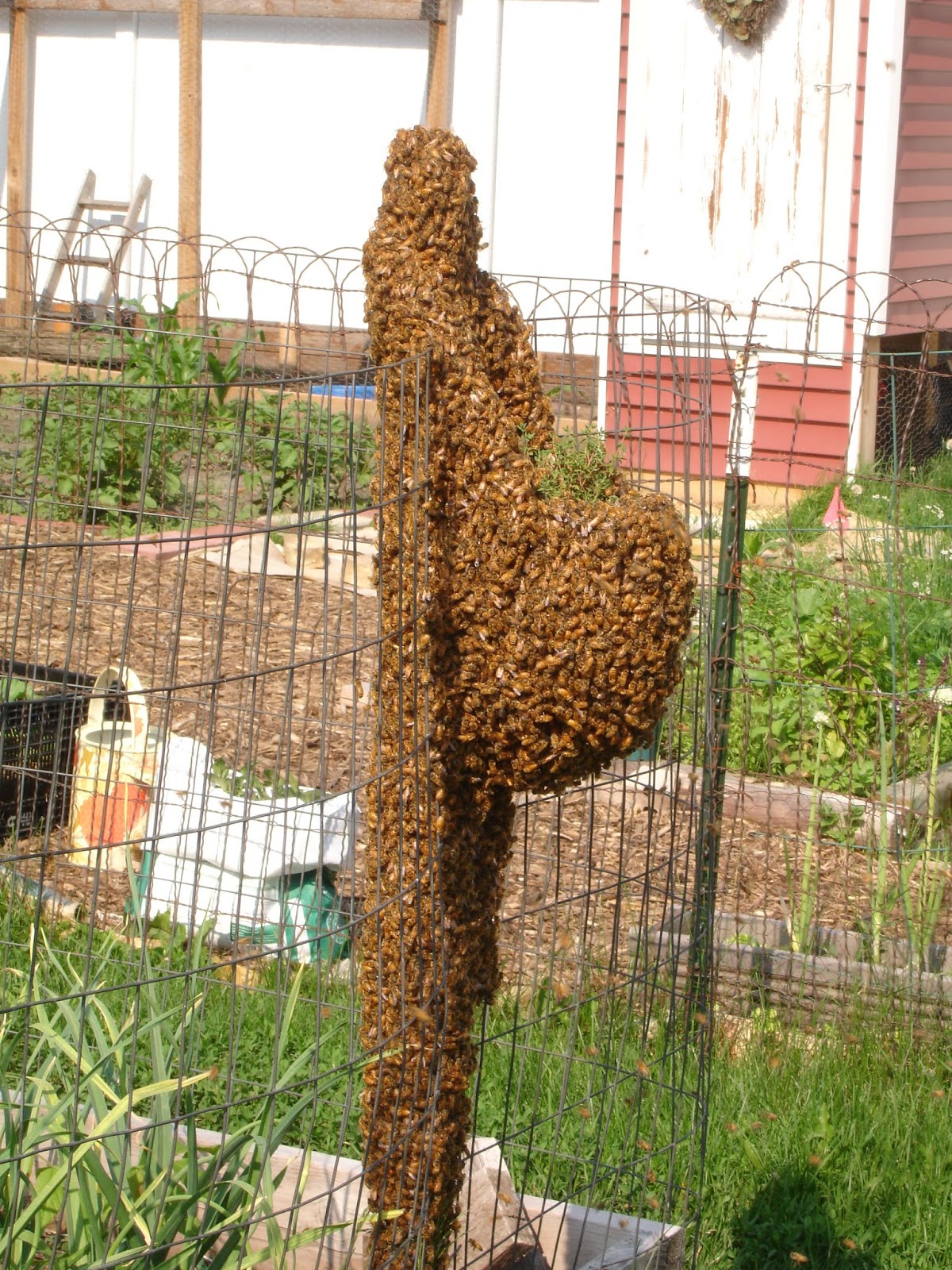 |
| Huge swarm, close to the ground. Easy to catch |
 |
| Swarm cells can be anywhere. Always look down on the top bars for swarm cells. |
 |
| Capped and uncapped swarm cells |
The only way to beat swarming is by checking your bees weekly for swarm cells. If you aren't checking for swarm cells in all the boxes every seven days and the timing gets longer than that, a swarm can happen. All the boxes need to be checked. Any uncapped swarm cells should be removed. If you come across capped swarm cells you may have been too late and the hive has already swarmed. Don't remove capped swarm cells. That may be your new queen.
The result of a hive that has swarmed is no eggs or young larvae. As older house bees come of age for foraging, it is very common that the brood box will be packed with nectar. A swarm hive queen won't start laying eggs for about three weeks. In that time the bees may fill the open cells. Now the beekeeper may have a dilemma of a honey bound hive. The only way to fix this is to spread nectar bound frames to other colonies or to extract the nectar to give the queen a whole deep brood box for laying eggs into.
Everyone should be removing their entrance reducers by now. The bees need ventilation with the increased hive populations.
Supers should be on all overwintered colonies.
Package colonies, once the bees have finished drawing out their brood boxes, the beekeeper should do a full reversal. Top box to the bottom, bottom box to top. The reason for this last reversal is to bring frames with pollen to the top. The bees will fill these pollen frames and empty brood cells with honey for their winter stores. Next February when the queen starts laying, as the bees consume honey in the top box, the bees will expose pollen. This pollen will be used for feeding larvae. If the bees don't have this pollen, production of brood may be delayed.
If the new hive finishes their top box more towards the end of June it may be too late to do the reversal. If the top box is very heavy with honey, do not do a reversal. It is too late, the bees have filled the box with honey and that is the bees winter honey. To supplement pollen on these colonies, pollen patties should be put on these colonies around the third week of February. Normally pollen patties are put on colonies around the first of March.
The nectar flow is right around the corner, keep the bees from swarming and there should be some honey in the supers.
Tuesday, June 2, 2020
Solar power generated in the month of May
It was a good solar month. 2300 kilowatts. More than twice what we would normally use. The excess power was sold back to the grid and Xcel energy.
The best day was 115 kilowatts. The worst day was 12 kilowatts.

The best day was 115 kilowatts. The worst day was 12 kilowatts.

Subscribe to:
Posts (Atom)
