Here is the video I promised about our solar ground mount. Finally got it up and running. If you are interested.
In my opinion the tilting ground mount is the way to go with solar panels. You can always change the angle over the year to get the most solar out of your solar panels. Removing snow is a breeze. Some folks can only put solar panels on a roof system, and thats fine. The solar still works well.
Some municipalities don't allow ground mount systems. Plus ground mount systems usually cost more than a roof mount. But, I have some construction friends that helped to make this all possible. I did call the solar company before I did anything, to see if they would put the panels on the ground mount if I built it. They were ok with it. Some companies may not do this because they would be afraid they may be assuming liability with the ground mount.
The ground mount is from MT Solar. The ground mount is called a multi pole mount. It holds 28 - 60 cell solar panels.
Sunday, April 26, 2020
Friday, April 24, 2020
Nature's Nectar Queen Update
Nature's Nectar is temporarily out of queens. They will be getting another shipment on Thursday April 30th.

Moved bees from Nucs to new equipment
Being the weather looks like it has stabilized and we seem to be into a more spring weather pattern, I have moved the package bees that I started in five frame nuc boxes into new 10 frame equipment.
By having the nucs in close proximity to the hives that the bees will being moved into. The bees know where they live. So when the frames are moved into the 10 frame equipment, the nucs are taken away, and the bees quickly discover their new hive.
 |
| I set the nucs in front of the hives they were going into. They have been there for several days. They are flying and bringing in pollen. The equipment they are sitting in front of is getting retired. |
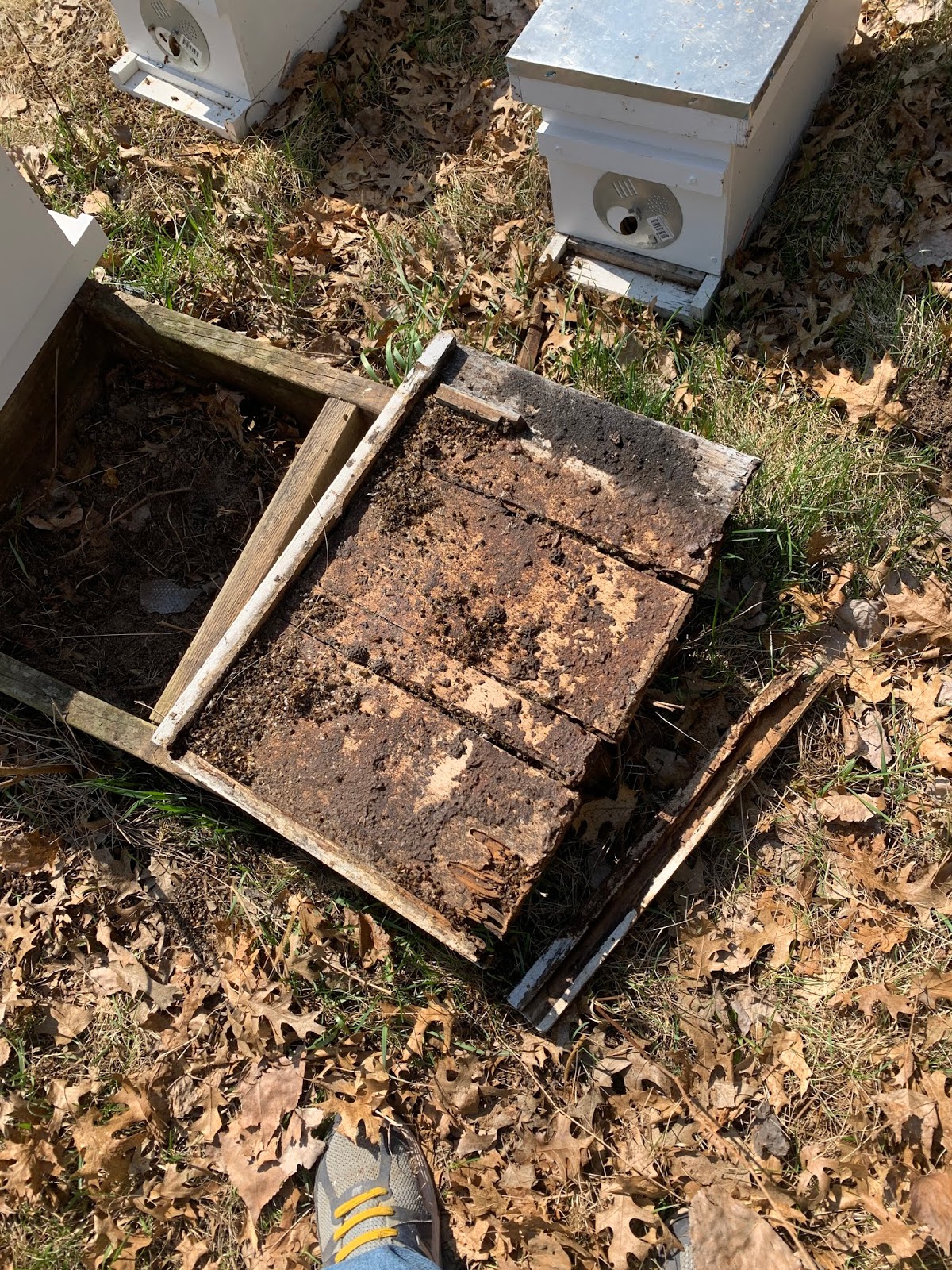 |
| This is a pretty tough looking bottom board |
 | ||
| I have set the new equipment in place. You can see that the nuc is not overcrowded and has ample space for a three pound package of bees |
 |
| The new hives are set and frames are on the outside edges of the hive. I have a frame of honey in the hive and I will add a new 1/2 patty of a pollen patty. |
 |
| When you remove a frame from the nuc box, do so carefully. The queen could be on any frame. In this pic, I picked the outside frame with the least amount of bees on it. I was right, the queen was on a different frame. I then added the rest of the nuc frames to the 10 frame box. |
 |
| This was one of my insulated boxes I made. I put the frames in the 10 frame box and fed the bees ProSweet. There was not a lot of food left in the nuc. So my interaction with the bees was well timed. |
 | |
| Here is the end result. I put bricks on the lids to hold them down. The third hive has a brick standing on end. This is my signal to check the queen on my next visit. |
Tuesday, April 21, 2020
Queens available starting April 23rd
Nature's Nectar LLC will have queens available starting on April 23rd. They will get a new shipment of Queens each week though May. Queen pickup is at the Oakdale store only.
QUEENS: This is CASH OR CHECK discounted pricing. Using a Credit Card, add $1.50 per queen.
MARKED Carniolan, Italian and Saskatraz: (no unmarked queens this year)
$39 for Italian & Carniolan
$41 for Saskatraz
QUEENS: This is CASH OR CHECK discounted pricing. Using a Credit Card, add $1.50 per queen.
MARKED Carniolan, Italian and Saskatraz: (no unmarked queens this year)
$39 for Italian & Carniolan
$41 for Saskatraz
Friday, April 17, 2020
Nature's Nectar LLC will be getting some more package bees
Nature's Nectar LLC will be getting a few more package bees. Call Tom or Jessy if you are interested or for more information. 651-242-2233.
Reversals on overwintered colonies
 |
| Don't let your strong overwintered colony to get to this point. This beekeeper had the winter cover on too long. But in his defense, 2017 was a cold spring. |
- If you have eggs in the top box, do a reversal. Top box to the bottom, bottom box to the top. If you see swarm cells remove them before the cells are capped. If the bees cap the swarm cells they may have swarmed on you.
- During your weekly visits to your overwintered hives, if you see eggs in the top box, do a reversal. You may do several reversals before you do a divide.
- Doing reversals on strong overwintered colonies, gives the queen more open cells to lay eggs into.
- If your colony is very strong and it is in two deep boxes and you have swarm concerns, add a third box to the hive. Having a third box on the hive makes doing the divide easier to do. When the divide happens, one of the boxes is removed. This leaves two deep boxes on the parent, which is where you want to be anyway.
- If you do add a third box and all you have is foundation, you will need to feed the colony syrup or the bees will not draw out the comb. A strong colony may draw out this box very quickly. If you start drawing a third box of foundation, that box has to stay on top while the bees are drawing out the comb. If you need to, the lower two boxes could be reversed with each other, during this process.
The days are warming up, pollen will be widely available this week. Keep pollen patties on the hive. Strong overwintered colonies demand for pollen sometimes in the spring is more than the colony can collect from nature. Especially when the daily high temperatures are in the low 60's. A pollen patty is cheap insurance that the hives protein demands are being met.
Wednesday, April 15, 2020
Checking for Queen acceptance
If you started packages recently, a hive check for queen acceptance is mandatory. A week after hiving package, it is time to look for eggs in the comb. Seeing eggs is the easy way to know that you have a laying queen.
If you don't check for this, you may end up not knowing that your hive is queenrite or not. If the queen was not accepted, a new queen must be purchased and introduced. It can take up to ten days for a new queen to start laying.
Late this week the weather will be warming up, perfect time to check.
If you don't check for this, you may end up not knowing that your hive is queenrite or not. If the queen was not accepted, a new queen must be purchased and introduced. It can take up to ten days for a new queen to start laying.
Late this week the weather will be warming up, perfect time to check.
 |
| Different egg and larvae and capped brood stages |
 |
| Different stages of larvae. You can see the Royal Jelly in the young small larvae stage. |
Subscribe to:
Posts (Atom)
